Xiamen Tmax Battery Equipments Limited was set up as a manufacturer in 1995, dealing with lithium battery equipments, technology, etc. We have total manufacturing facilities of around 200000 square foot and more than 230 staff. Owning a group of experie-nced engineers and staffs, we can bring you not only reliable products and technology, but also excellent services and real value you will expect and enjoy.
Sodium Battery Machine: Overview, Features, Manufacturing Process, Applications, Advantages, and Conclusion
A sodium battery machine is a specialized piece of equipment designed for the precise and efficient production of sodium-ion batteries. Sodium-ion technology is gaining attention as a cost-effective, sustainable, and environmentally friendly alternative to lithium-ion batteries due to the abundance and low cost of sodium. Sodium battery machines streamline critical production processes such as electrode preparation, cell assembly, electrolyte filling, and sealing, ensuring high-quality, reproducible battery cells suitable for research, pilot production, and industrial-scale manufacturing.
Overview
Sodium battery machines are engineered to handle sensitive materials such as sodium-based electrodes, separators, and electrolytes with high precision under controlled conditions. They support various battery formats, including pouch, cylindrical, and prismatic cells, and integrate automation to reduce human error, improve efficiency, and maintain product consistency. By ensuring precise electrode alignment, uniform electrolyte distribution, and reliable sealing, sodium battery machines produce cells that meet strict performance, safety, and durability standards.
Key Features of Sodium Battery Machines
Key features of sodium battery machines include:
Precision Electrode Handling: Accurate stacking or winding of anode, cathode, and separator layers for consistent cell performance.
Controlled Electrolyte Filling: Ensures uniform wetting of electrodes, optimizing ionic conductivity and battery efficiency.
Vacuum or Inert Atmosphere Capability: Prevents moisture and oxygen contamination, protecting sensitive sodium materials.
Reliable Sealing Mechanisms: Heat or ultrasonic sealing provides airtight, mechanically robust battery cells.
Automation and Programmability: Adjustable parameters support multiple battery formats, sizes, and materials.
Integrated Quality Monitoring: Real-time inspection ensures proper electrode placement, electrolyte distribution, and sealing integrity, reducing defects.
Manufacturing Process
The manufacturing process using a sodium battery machine generally involves:
Electrode Preparation: Cutting, coating, and drying sodium-ion anodes and cathodes with precise specifications.
Stacking or Winding: Electrodes and separators are carefully arranged in stacked or rolled configurations inside the battery casing.
Electrolyte Injection: Controlled filling ensures complete wetting of electrodes for optimal ion transport.
Sealing: Heat or ultrasonic sealing encapsulates the battery, providing airtight and mechanically stable protection.
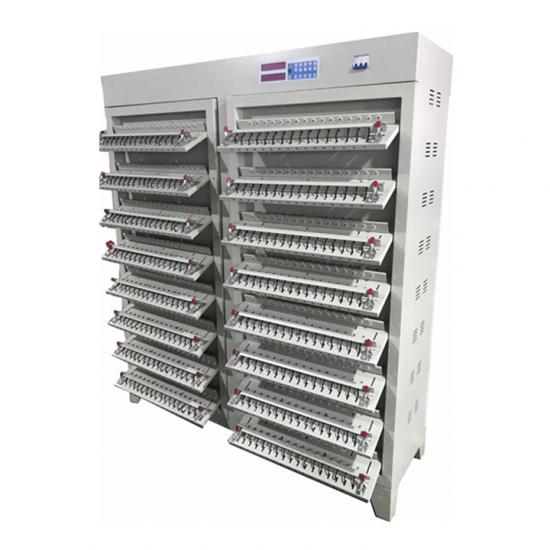
Formation and Testing: Initial charge-discharge cycles stabilize the battery, by performance evaluation of key parameters such as capacity, voltage, and internal resistance.
Advanced machines may include automated material handling, vacuum-assisted electrolyte filling, and inline quality inspection to enhance reproducibility, efficiency, and safety.
Sodium Ion Battery Stacking Machine
Applications
Sodium battery machines are used in multiple sectors:
Electric Vehicles: Producing battery packs for cars, buses, scooters, and e-bikes.
Renewable Energy Storage: Manufacturing batteries for solar, wind, and hybrid grid storage systems.
Consumer Electronics: Sodium-ion batteries for laptops, power banks, and portable devices.
Backup Power Systems: UPS and emergency energy storage solutions.
Research and Development: Prototype fabrication, material testing, and pilot-scale production.
Advantages
The main advantages of sodium battery machines include:
High Precision and Consistency: Ensures uniform electrode placement and electrolyte distribution, improving battery reliability.
Scalability: Suitable for laboratory, pilot, and industrial-scale production.
Cost-Effectiveness: Uses abundant sodium, reducing battery production costs.
Enhanced Safety: Airtight sealing and controlled production environments minimize leakage and short-circuit risks.
Flexibility: Compatible with various cell formats, chemistries, and sizes.
Quality Assurance: Integrated monitoring systems maintain high production standards and reduce defective units.
Conclusion
In conclusion, a sodium battery machine is an essential tool for producing high-quality, safe, and cost-effective sodium-ion batteries. By combining precise electrode handling, controlled electrolyte filling, vacuum or inert gas processing, and reliable sealing, these machines ensure reproducible, high-performance battery cells. Widely applicable in electric vehicles, renewable energy storage, consumer electronics, and backup power systems, sodium battery machines enable both research-scale experimentation and large-scale industrial manufacturing. With their precision, efficiency, scalability, and safety, they play a pivotal role in advancing sustainable and next-generation energy storage technologies.



 IPv6-Netzwerk unterstützt
 de
de en
en fr
fr ru
ru es
es pt
pt ko
ko tr
tr pl
pl th
th


