Xiamen Tmax Battery Equipments Limited was set up as a manufacturer in 1995, dealing with lithium battery equipments, technology, etc. We have total manufacturing facilities of around 200000 square foot and more than 230 staff. Owning a group of experie-nced engineers and staffs, we can bring you not only reliable products and technology, but also excellent services and real value you will expect and enjoy.
Solid State Battery Laboratory Plant: Advanced Equipment for Research, Development, and Pilot-Scale Manufacturing
Overview
A Solid State Battery Laboratory Plant is a specialized research and pilot-scale manufacturing facility designed to support the development, prototyping, and evaluation of next-generation all-solid-state batteries (ASSBs). Unlike large-scale commercial production lines, a laboratory plant focuses on material innovation, process optimization, cell prototyping, and performance validation while maintaining the flexibility required for scientific research and small-batch production.
As solid-state battery technology gains momentum in electric vehicles, consumer electronics, aerospace, and renewable energy storage, research institutions and battery manufacturers require highly integrated laboratory equipment capable of producing reliable prototype cells under controlled conditions. A modern Solid State Battery Laboratory Plant combines precision processing equipment, intelligent automation, environmental control systems, and advanced analytical instruments into a compact yet highly versatile platform.
Typical equipment includes powder processing systems, vacuum mixers, tape casting machines, coating equipment, calendaring machines, precision cutting systems, hot pressing units, electrolyte fabrication equipment, glove boxes, stacking machines, lamination systems, coin cell and pouch cell assembly equipment, formation systems, and comprehensive electrochemical testing instruments. Together, these systems provide researchers with the capability to investigate new materials, optimize manufacturing processes, and accelerate the commercialization of advanced battery technologies.
---
Key Characteristics
A modern Solid State Battery Laboratory Plant is designed to meet the demanding requirements of battery research while offering flexibility for continuous technological innovation.
High-Precision Equipment
Laboratory-scale production requires exceptional accuracy. Precision coating, pressing, cutting, and stacking equipment ensures uniform electrode thickness, electrolyte density, and cell assembly accuracy, enabling reproducible experimental results.
Flexible Configuration
Unlike commercial production lines dedicated to a single battery format, laboratory plants support multiple cell configurations, including coin cells, pouch cells, laminated cells, and small prismatic cells. Equipment modules can be easily reconfigured to accommodate new research projects.
Controlled Research Environment
Most processing steps are performed inside dry rooms or inert-atmosphere glove boxes with extremely low moisture and oxygen levels. This controlled environment protects moisture-sensitive solid electrolytes and lithium metal from degradation.
Intelligent Process Control
Modern laboratory plants integrate programmable logic controllers (PLCs), touchscreen interfaces, and data acquisition systems for accurate process control. Researchers can monitor temperature, pressure, coating speed, vacuum level, and other critical parameters in real time.
Compact and Modular Design
Laboratory equipment is designed to occupy minimal space while maintaining high functionality. Modular layouts allow research facilities to expand capabilities gradually as project requirements evolve.
---
Manufacturing Process
A Solid State Battery Laboratory Plant follows a carefully controlled workflow that replicates commercial production while allowing greater flexibility for experimentation.
Material Preparation
The process begins with the preparation of active cathode materials, anode materials, conductive additives, binders, and solid electrolyte powders. High-energy ball mills, planetary mixers, and vacuum mixing systems produce homogeneous mixtures with optimized particle size distribution.
Electrode Fabrication
Prepared slurries are coated onto metal current collectors using laboratory coating machines with adjustable thickness control. After coating, electrodes are dried in precision ovens before undergoing calendaring to achieve the required density and surface flatness.
Solid Electrolyte Fabrication
Solid electrolytes are produced using techniques such as tape casting, dry pressing, hot pressing, or sintering. The chosen process depends on the electrolyte type, including oxide-based, sulfide-based, polymer-based, or composite solid electrolytes.
Electrode Cutting
Precision die cutting or laser cutting equipment prepares electrodes with consistent dimensions suitable for laboratory cell assembly.
Cell Assembly
Battery components are assembled inside glove boxes under inert gas conditions. Automated or semi-automatic stacking machines accurately position electrodes and solid electrolyte layers to minimize interfacial resistance.
Lamination and Pressing
Hot pressing or cold isostatic pressing equipment applies controlled pressure to improve contact between the electrode and electrolyte layers, enhancing ionic transport and electrochemical performance.
Cell Packaging
Depending on the battery format, assembled cells are sealed using laboratory vacuum sealing machines or precision crimping equipment for coin cells. Airtight sealing prevents contamination during subsequent testing.
Formation and Testing
The finished cells undergo formation cycling using battery analyzers that perform controlled charging and discharging. Electrochemical impedance spectroscopy (EIS), cycle-life testing, rate capability evaluation, and thermal analysis provide detailed performance data for further optimization.
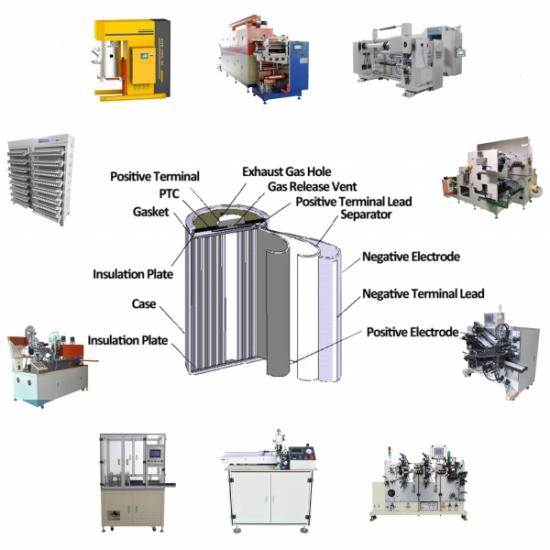
Cylindrical Cell Assembly Plant
Applications
The versatility of a Solid State Battery Laboratory Plant supports numerous research and development activities.
Battery Material Development
Researchers use laboratory plants to evaluate new cathode materials, anode materials, solid electrolytes, conductive additives, and interface modification technologies.
Prototype Cell Manufacturing
Laboratory facilities produce prototype batteries for validating new designs before scaling up to pilot or commercial production.
University Research
Academic institutions utilize laboratory plants for teaching electrochemistry, materials science, and battery engineering while conducting advanced research on energy storage technologies.
Industrial Research and Development
Battery manufacturers employ laboratory plants to optimize production processes, improve battery performance, and accelerate product commercialization.
Pilot-Scale Process Verification
Laboratory plants bridge the gap between fundamental research and commercial manufacturing by validating equipment parameters and process stability under realistic production conditions.
Quality Evaluation
Integrated analytical instruments enable comprehensive testing of battery capacity, internal resistance, cycle life, safety characteristics, ionic conductivity, and interface stability.
---
Advantages
A Solid State Battery Laboratory Plant offers numerous advantages for battery researchers and manufacturers.
* Comprehensive Research Platform: Integrates all essential equipment required for material preparation, cell fabrication, assembly, and testing within a single laboratory environment.
* High Experimental Flexibility: Modular equipment allows rapid adjustment of process parameters and supports multiple battery chemistries and cell formats.
* Improved Research Efficiency: Automated systems reduce manual operations, increase reproducibility, and shorten development cycles.
* Excellent Process Repeatability: Precision manufacturing equipment ensures consistent sample preparation and reliable experimental data.
* Scalable Technology Development: Laboratory processes can be optimized and transferred efficiently to pilot-scale and commercial production lines.
* Advanced Data Collection: Real-time monitoring and digital process management provide valuable insights for process optimization and quality control.
* Cost-Effective Innovation: Small-batch production minimizes material consumption while enabling rapid evaluation of new battery concepts and manufacturing techniques.
---
Conclusion
A Solid State Battery Laboratory Plant serves as a critical platform for advancing the research, development, and pilot-scale production of next-generation solid-state batteries. By combining precision processing equipment, controlled environmental systems, intelligent automation, and comprehensive testing instruments, these laboratory plants provide researchers with the tools necessary to develop safer, higher-energy, and longer-lasting battery technologies.
As industries accelerate the transition toward electric mobility, renewable energy storage, and high-performance portable electronics, the importance of laboratory-scale battery manufacturing continues to grow. A well-equipped Solid State Battery Laboratory Plant enables rapid material innovation, reliable prototype fabrication, and efficient process optimization, significantly shortening the path from scientific discovery to commercial production. With ongoing advances in solid electrolytes, electrode materials, and intelligent manufacturing technologies, these laboratory facilities will remain indispensable in shaping the future of advanced energy storage systems.



 IPv6-Netzwerk unterstützt
 de
 en
 fr
 ru
 es
 pt
 ko
 tr
 pl
 th



